
Bristol Salon has moved to a new dedicated website.
* Note: you are being taken to an external site. *
Bristol Salon is NOW open for entires – CLICK FOR MORE INFO
Great Western Photographic Exhibition (BPE) is NOW open for entires – CLICK FOR MORE INFO
Clubrooms
The Clubrooms consist of a meeting space / lecture room equipped at present with, display area, display boards, toilet, kitchen, library. The main lecture space also houses the club’s fully equipped studio space. See below for further details.
Ground Floor
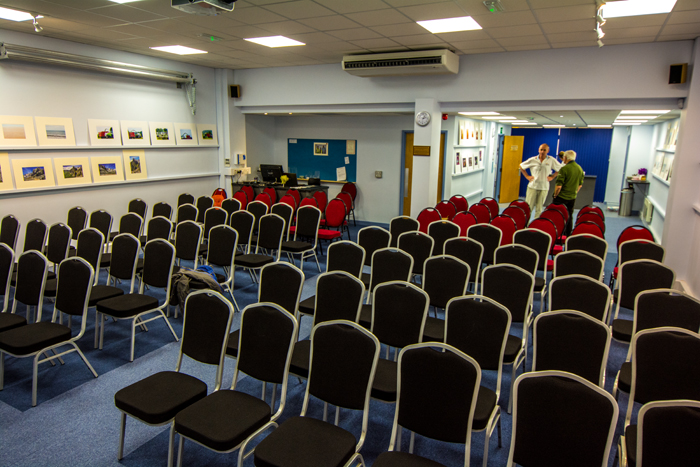
Meeting Room > View front of stage and the PC desk at the back of the room
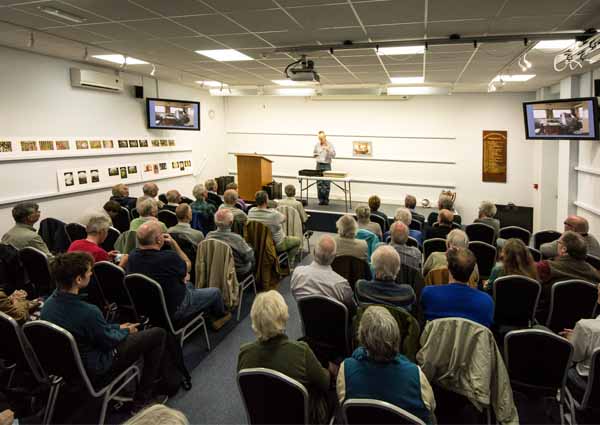
Clubroom in Action
First Floor
Tea & Coffee Area
Studio Space
The Studio space is available for hire, the cost depending upon the hirer and the purpose and subject to the hire terms and conditions
– Members can hire the studio for personal use at a reduced fee of £35 per session (no hourly rate)
– Non-members may hire the studio for their personal use at a very competitive £50 per session (no hourly rate).
– Commercial use is also permitted at a cost of £200 per day / part day.
* Commercial use is defined as any purpose where one or more attendees are being charged a fee to attend, for example, workshops or where there is a client paying for the output of the session or where the photographs are being used in connection with any business, whether owned by themselves or any third party.
For the avoidance of doubt, a model charging a photographer for their time where the images are intended for personal use only (individual projects, display on personal social media, portfolios, or entered in exhibitions or competitions) would not be considered as Commercial use.
If the images are used to promote goods / brands / products or services, or use on commercial revenue earning sites, that would be considered as being Commercial usage.
Ruling as to what constitutes personal or commercial use is at the sole discretion of the Studio Manager whose decision is final.
Library
The library currently has about 160 books and is open most Wednesday evenings in the clubrooms.*COVID-19
Currently due to Covid 19 the club is not meeting physically. Bristol Photographic Society is still active with weekly meetings via Zoom (including some international speakers) – new members are always welcome.
As a special concession, prospective members may join the first three Zoom meetings free of charge as a trial before full memberships is payable.
Contacts
If you would like general information about booking the clubrooms for your own organisation, please contact the Bookings Manager, bookings@bristolphoto.org.uk
Booking requests should be made to the Studio Manager, studiobookings@bristolphoto.org.uk
Unit 13 Montpelier Central | Station Road | Montpelier | Bristol BS6 5EE




Unit 13 Montpelier Central | Station Road | Montpelier | Bristol BS6 5EE
Registered Charity No. 297259 | Registered in England No. 2004478
Copyright © 2024 Bristol Photographic Society. All rights reserved.
| Cookie | Duration | Description |
|---|---|---|
| cookielawinfo-checbox-analytics | 11 months | This cookie is set by GDPR Cookie Consent plugin. The cookie is used to store the user consent for the cookies in the category "Analytics". |
| cookielawinfo-checbox-functional | 11 months | The cookie is set by GDPR cookie consent to record the user consent for the cookies in the category "Functional". |
| cookielawinfo-checbox-others | 11 months | This cookie is set by GDPR Cookie Consent plugin. The cookie is used to store the user consent for the cookies in the category "Other. |
| cookielawinfo-checkbox-advertisement | 1 year | The cookie is set by GDPR cookie consent to record the user consent for the cookies in the category "Advertisement". |
| cookielawinfo-checkbox-necessary | 11 months | This cookie is set by GDPR Cookie Consent plugin. The cookies is used to store the user consent for the cookies in the category "Necessary". |
| cookielawinfo-checkbox-performance | 11 months | This cookie is set by GDPR Cookie Consent plugin. The cookie is used to store the user consent for the cookies in the category "Performance". |
| viewed_cookie_policy | 11 months | The cookie is set by the GDPR Cookie Consent plugin and is used to store whether or not user has consented to the use of cookies. It does not store any personal data. |
| Cookie | Duration | Description |
|---|---|---|
| _ga | 2 years | This cookie is installed by Google Analytics. The cookie is used to calculate visitor, session, campaign data and keep track of site usage for the site's analytics report. The cookies store information anonymously and assign a randomly generated number to identify unique visitors. |
| _gat_gtag_UA_141671453_1 | 1 minute | Google uses this cookie to distinguish users. |
| _gid | 1 day | This cookie is installed by Google Analytics. The cookie is used to store information of how visitors use a website and helps in creating an analytics report of how the website is doing. The data collected including the number visitors, the source where they have come from, and the pages visted in an anonymous form. |
| Cookie | Duration | Description |
|---|---|---|
| _ga_PW0V130FEV | 2 years | No description |
| CONSENT | 16 years 9 months | No description |
| happyforms_checkout | past | No description |
| happyforms_ga_session | session | No description |

Using the Contact Form
If you have any questions please contact us using the form on the right, selecting a recipient from the dropdown menu.
Please Note: If you are contacting the Society with information that you would like circulated to all members, please send your request to the Newsletter Editor ONLY.
By Post
Unit 13
Montpelier Central
Station Rd
Montpelier
Bristol, BS6 5EE
Bristol Salon has moved to a new dedicated website.
* Note: you are being taken to an external site. *